









Thursday, May 12, 2011
Persephone
Anyway, Persephone was the daughter of Zeus and Demeter. This whole story starts (about the skirts) because Persephone (in her loveliness and perfect innocence) was out picking myrtle...


Tuesday, March 22, 2011
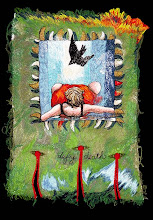
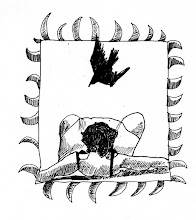
about Still Waves, Defy Death (and the other figures with skirts raised facing into the page)
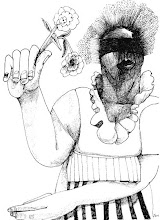
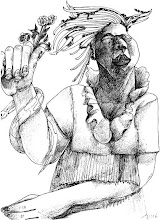
A friend recently asked me " How can raising your skirts still waves". Such a good question, the basic idea is that raising the skirts exposes the source of all life.
It is a symbolic gesture of course with ancient origins, but the essence of this whole story is the power in that recognition; the gesture exposes the source of all life. Now what is that about? Does that heal? is it simply an expression of creative power? is it useful in this world or does it merely confuse?
I wanted to include here a quote from one of our main sources " The Metamorphosis of Baubo" by Winifred Milius Lubell.
" I think it would be a sad mistake for us to lose sight of Baubo and her icon, the vulva, to relinquish her playful joking, to let her slide out of Western consciousness into scholarly obscurity or into the netherworld of demons and pornography. Her strangeness to modern eyes warns of the danger of her loss. But Baubo is a survivor. She has constantly refused to stay put in a single or confining role of womanhood. She is irreverent she is sacred. She represents those revered sexual and procreative feminine energies that merge to form the nurturers, the transformers and the balancers without whom civilization cannot survive. Baubo's arresting gesture of exposure holds the clue to understanding all the metamophoses of this complex and enigmantic figure."
It is a symbolic gesture of course with ancient origins, but the essence of this whole story is the power in that recognition; the gesture exposes the source of all life. Now what is that about? Does that heal? is it simply an expression of creative power? is it useful in this world or does it merely confuse?
I wanted to include here a quote from one of our main sources " The Metamorphosis of Baubo" by Winifred Milius Lubell.
" I think it would be a sad mistake for us to lose sight of Baubo and her icon, the vulva, to relinquish her playful joking, to let her slide out of Western consciousness into scholarly obscurity or into the netherworld of demons and pornography. Her strangeness to modern eyes warns of the danger of her loss. But Baubo is a survivor. She has constantly refused to stay put in a single or confining role of womanhood. She is irreverent she is sacred. She represents those revered sexual and procreative feminine energies that merge to form the nurturers, the transformers and the balancers without whom civilization cannot survive. Baubo's arresting gesture of exposure holds the clue to understanding all the metamophoses of this complex and enigmantic figure."
Sunday, March 13, 2011
Art Statement for show
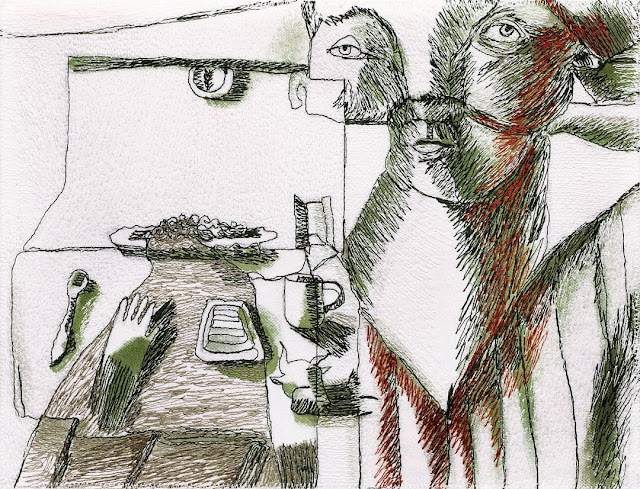
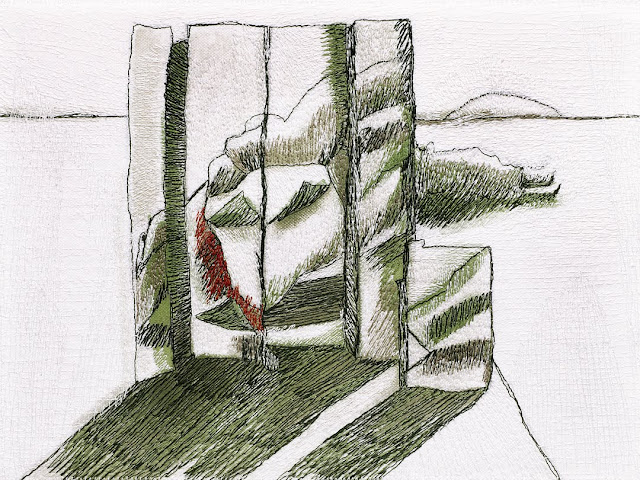
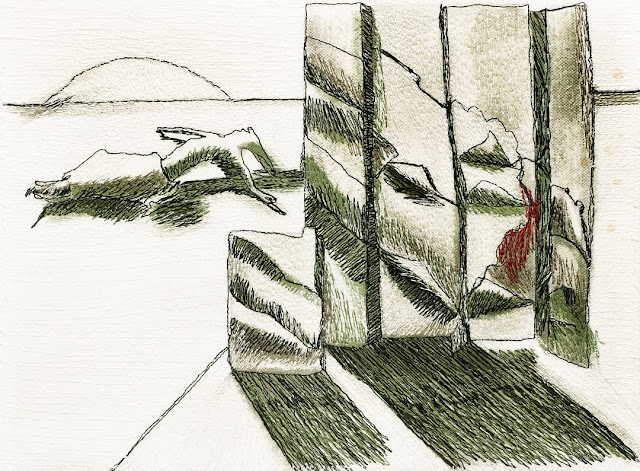
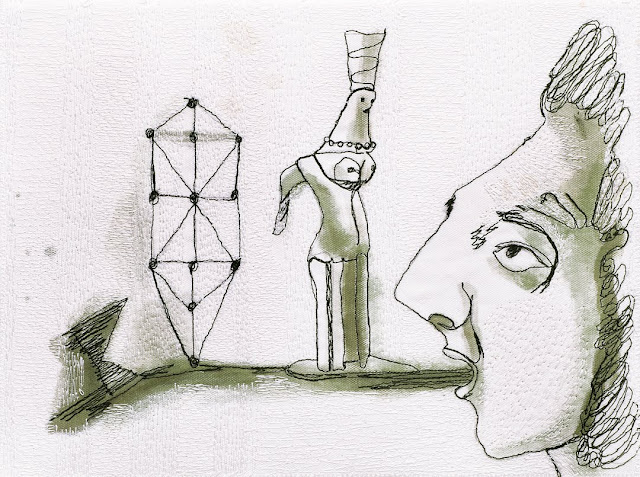
The work for 1001 Funny Things began as research on the history and mythology of the skirt.
Writer Elizabeth Dancoes has done brief, original stories based on our research but in contemporary idiom.
In total we have worked together on approximately 10 stories, three of these are forming the basis for this exhibit. They are Lunch, She Who Walks and Knowing.
The images and stories are based on the ancient, mysterious gesture known as “Ana Suromai”, literally “to raise the skirt”. The origins of this intriguing gesture come to light in the Demeter, Persephone story from Ancient Greece. The gesture haunts so much of subsequent mythology and story that it can hardly be ignored.
Ana Suromai (“to raise the skirt”) was an incitement to transformation. And while its spiritual implications were deep, it encouraged laughter as a conduit to renewal. It resonates in fables in the guise of mysterious things concealed beneath a woman’s skirt and continues into modern times with the ever-present and compelling image of Marilyn Monroe’s skirts billowing over a subway grate. As anyone who as ever work a skirt will tell you it is a spontaneous gesture.
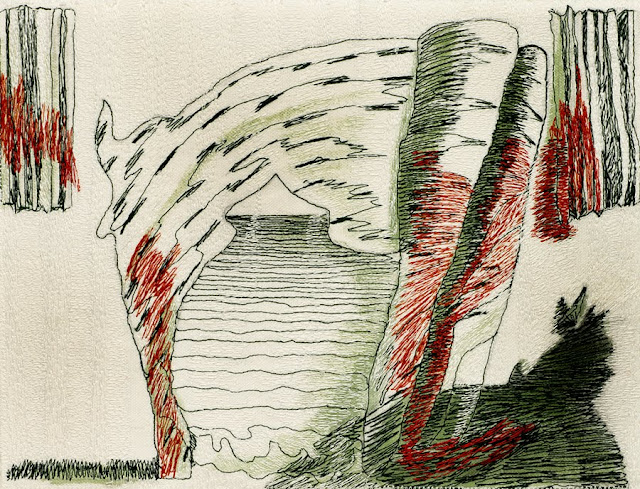
My work for the series includes drawings, paintings and embroideries as well as digital images that are made to resemble embroidery and traditional stitchery.
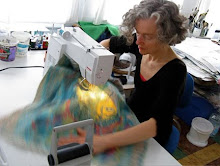
For me this work reflects my intense emotional, expressive involvement in cloth, in sewing and stitching cloth, in interpreting cloth in paint and in pure, unadulterated, long hand stitching, the stitch as a teller of tales taking in and speaking with each breath, with each passing of thread through cloth.
Though the images reflect the humour and magic of Elizabeth’s stories, it was the sharing of our respective experiencing of the gesture of “Ana Suromai” that inevitably inspired the revelations that inform the visual notions that run through both text and image. We initially worked simultaneously on the evolution of one set of image and story then she wrote for my drawings, as we evolved Elizabeth wrote and I interpreted. Part of our desire for this exhibit it to share the methods and means of this ongoing, productive collaboration.
Writer Elizabeth Dancoes has done brief, original stories based on our research but in contemporary idiom.
In total we have worked together on approximately 10 stories, three of these are forming the basis for this exhibit. They are Lunch, She Who Walks and Knowing.
The images and stories are based on the ancient, mysterious gesture known as “Ana Suromai”, literally “to raise the skirt”. The origins of this intriguing gesture come to light in the Demeter, Persephone story from Ancient Greece. The gesture haunts so much of subsequent mythology and story that it can hardly be ignored.
Ana Suromai (“to raise the skirt”) was an incitement to transformation. And while its spiritual implications were deep, it encouraged laughter as a conduit to renewal. It resonates in fables in the guise of mysterious things concealed beneath a woman’s skirt and continues into modern times with the ever-present and compelling image of Marilyn Monroe’s skirts billowing over a subway grate. As anyone who as ever work a skirt will tell you it is a spontaneous gesture.
My work for the series includes drawings, paintings and embroideries as well as digital images that are made to resemble embroidery and traditional stitchery.
For me this work reflects my intense emotional, expressive involvement in cloth, in sewing and stitching cloth, in interpreting cloth in paint and in pure, unadulterated, long hand stitching, the stitch as a teller of tales taking in and speaking with each breath, with each passing of thread through cloth.
Though the images reflect the humour and magic of Elizabeth’s stories, it was the sharing of our respective experiencing of the gesture of “Ana Suromai” that inevitably inspired the revelations that inform the visual notions that run through both text and image. We initially worked simultaneously on the evolution of one set of image and story then she wrote for my drawings, as we evolved Elizabeth wrote and I interpreted. Part of our desire for this exhibit it to share the methods and means of this ongoing, productive collaboration.
Tuesday, March 8, 2011
A few things you should know
A few things you should know before the show:
A long time ago Persephone, the daughter of Zeus and Demeter, was abducted by Hades while out picking Myrtle. Demeter , beside herself with grief, went searching for her. Demeter was goddess of the earth and when the earth goddess grieves things get serious; no water, no crops, no food, no wine....
Demeter wandered searching and she came to the home of the King and Queen of Eleusis where it was her intention to rest (in disguise).
Baubo, a servant in the household, felt deep compassion for Demeter and after having given her as a special drink made from barley danced for her wildly, raising her skirt, in a wild gesture where she raised her skirt, it was said that the gesture made Demeter laugh (uproariously) bringing her out of her grief and giving her hope. The gesture is called “Ana Suromai”- to raise the skirts- the gesture is the basis for these stories.
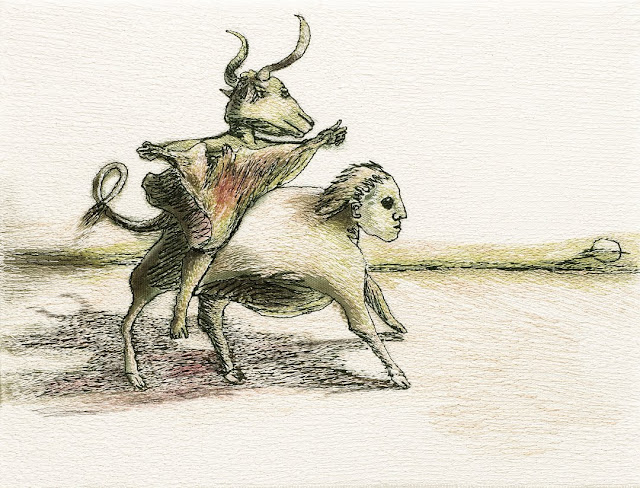
Note: the “1001 funny things” refers to the “too numerous to count” incidents, stories and myths throughout story telling history that have as there source and meaning this powerful gesture. Elizabeth and I (early on in our work on these stories) discovered the four on which this exhibit is based : Cow Bulls, Still Waves, Blind the Devil, Defy Death.
A long time ago Persephone, the daughter of Zeus and Demeter, was abducted by Hades while out picking Myrtle. Demeter , beside herself with grief, went searching for her. Demeter was goddess of the earth and when the earth goddess grieves things get serious; no water, no crops, no food, no wine....
Demeter wandered searching and she came to the home of the King and Queen of Eleusis where it was her intention to rest (in disguise).
Baubo, a servant in the household, felt deep compassion for Demeter and after having given her as a special drink made from barley danced for her wildly, raising her skirt, in a wild gesture where she raised her skirt, it was said that the gesture made Demeter laugh (uproariously) bringing her out of her grief and giving her hope. The gesture is called “Ana Suromai”- to raise the skirts- the gesture is the basis for these stories.
Note: the “1001 funny things” refers to the “too numerous to count” incidents, stories and myths throughout story telling history that have as there source and meaning this powerful gesture. Elizabeth and I (early on in our work on these stories) discovered the four on which this exhibit is based : Cow Bulls, Still Waves, Blind the Devil, Defy Death.
Friday, February 18, 2011
Elizabeth's Ana Suromai
Lifting Our Skirts
Background information
Setting: Greece
Time: lost in the mists BCE
Event: Demeter is raped by Zeus gives birth to Persephone.
Persephone is raped by Hades (with the support of Zeus) gives birth to Iaachus
The Eleusinian Mysteries follow
Involving the pivotal act of ana suromai – the lifting of the skirt
The mythic moment of ana suromai:
The Goddess is laden/troubled/despairing. Her daughter has been ravished/raped/ abducted and her rage has brought an end to productivity/fertility/invention. The world trembles at her vengeance. All fear catastrophe. They claim this very thing has happened before.
But by the wild fig tree/poor peasant hut/crossroads, a hearty serving maid/pregnant wife/ wild woman waits. She waits, her desire restrained/tucked/concealed, secret beneath her skirts. She waits and so is there when the Goddess passes.
The maid/wife/woman throws/falls/dances herself onto her back, her thighs spread and beckoning. She murmurs/whispers/laughs lewdly.
An intoxicating whiff of desire escapes the Goddess. She marvels as this bubble of life force erupts from the blight of her mourning. She wonders at the maid/wife/woman’s rashness: how can the mortal know it is good that looks her in the eye? The maid/wife/woman winks provocatively. Should it matter?
The Goddess finds her grief/despair/rage relieved infinitesimally, but it is enough. Possibility has reinvented itself in the distraction, whispers of negotiation and compromise have been impressed on her divine ear. She walks
in reverie, her passage marked by bounty, abundance escaping her skirts.
Background information
Setting: Greece
Time: lost in the mists BCE
Event: Demeter is raped by Zeus gives birth to Persephone.
Persephone is raped by Hades (with the support of Zeus) gives birth to Iaachus
The Eleusinian Mysteries follow
Involving the pivotal act of ana suromai – the lifting of the skirt
The mythic moment of ana suromai:
The Goddess is laden/troubled/despairing. Her daughter has been ravished/raped/ abducted and her rage has brought an end to productivity/fertility/invention. The world trembles at her vengeance. All fear catastrophe. They claim this very thing has happened before.
But by the wild fig tree/poor peasant hut/crossroads, a hearty serving maid/pregnant wife/ wild woman waits. She waits, her desire restrained/tucked/concealed, secret beneath her skirts. She waits and so is there when the Goddess passes.
The maid/wife/woman throws/falls/dances herself onto her back, her thighs spread and beckoning. She murmurs/whispers/laughs lewdly.
An intoxicating whiff of desire escapes the Goddess. She marvels as this bubble of life force erupts from the blight of her mourning. She wonders at the maid/wife/woman’s rashness: how can the mortal know it is good that looks her in the eye? The maid/wife/woman winks provocatively. Should it matter?
The Goddess finds her grief/despair/rage relieved infinitesimally, but it is enough. Possibility has reinvented itself in the distraction, whispers of negotiation and compromise have been impressed on her divine ear. She walks
in reverie, her passage marked by bounty, abundance escaping her skirts.
The Exhibit
In order to present this complex material so that it's comprehensible and can be enjoyed it will take this form : we have used as a start point four of the powers of a woman with her skirt raised (from ancient sources), they are Cow Bulls, Still Waves, Blind or melt the Devil, Defy Death the core of everything is Defy Death.
We have also used the two ideas of "ana suromai" (the raised skirt gesture) and the myths of what is under a woman's skirts (such as is represented in the Sheba story below {older post}).
We have also used the two ideas of "ana suromai" (the raised skirt gesture) and the myths of what is under a woman's skirts (such as is represented in the Sheba story below {older post}).
Some of our main resources
Here is our basic resource list for the mythology from which we have built the stories and the imagery.
Winifred Lubel: The Metamorphosis of Baubo
Carl Keneryi: Eleusis: Archetypal Image of Mother And Daughter
Marina Warner: The Beast and The Blonde
Robert Graves: Greek Myths
Robert Graves: The White Goddess
Rian Eisler: The Chalice and the Blade
Nor Hall: The Moon and The Virgin: Reflections on the Archetypal Feminine
Winifred Lubel: The Metamorphosis of Baubo
Carl Keneryi: Eleusis: Archetypal Image of Mother And Daughter
Marina Warner: The Beast and The Blonde
Robert Graves: Greek Myths
Robert Graves: The White Goddess
Rian Eisler: The Chalice and the Blade
Nor Hall: The Moon and The Virgin: Reflections on the Archetypal Feminine
Subscribe to:
Posts (Atom)